Gold vs S&P 500 Return Calculator – Should You Sell Your Gold and Invest in Stocks?
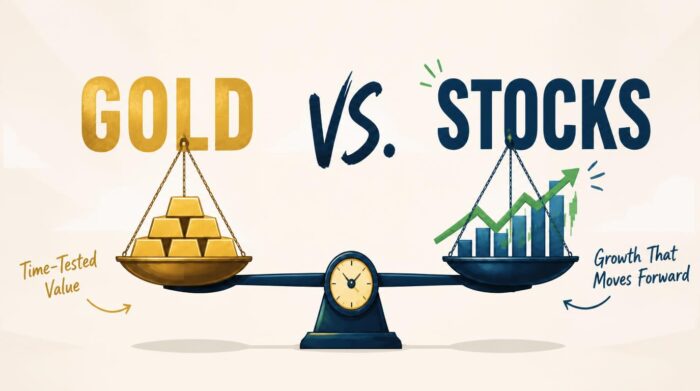
If you’ve got gold sitting in a drawer, buried in the backyard, locked away in a safe, or stored in a safe deposit box, you’ve probably asked yourself this question at some point: would that gold be working harder for me somewhere else?
It’s a fair question. Gold has a long track record as a store of value, but “store of value” and “growing my money” are two different jobs. To help you see the difference in real numbers, we built a Gold vs S&P 500 Return Calculator that projects how a given amount of money could grow over time under each scenario, using long-run historical average returns: approximately 8.8% annually for gold and approximately 11% annually for the S&P 500, based on roughly the past 50 years of performance.
We’ve talked to plenty of people who keep old gold tucked away saying they want to leave it to their children or grandchildren. Which is a great thought! But that idea, especially over a longer period of time, could be reducing the amount of inheritance you can leave.
Unless it’s a family heirloom that someone will cherish for personal reasons, history has shown it’s better to sell your gold and put that money to work.
Let’s walk through what those numbers actually mean, why the gap exists, and when it might – and might not – make sense to hold gold (or silver, or platinum) instead of stocks.
The Numbers: Gold vs. the S&P 500 Over 50+ Years
Over long stretches of market history, the S&P 500 has outpaced gold. Using average annualized returns of roughly 8.8% for gold and 11% for the S&P 500 (price appreciation plus reinvested dividends), the difference might look small on paper. However, compounding turns that gap into something enormous.
Here’s the simple version: a couple of percentage points of annual return, compounded over 30 or 40 years, is the difference between doubling your money a few times and doubling it several times over. That’s the entire premise behind our calculator. Punch in an amount and a time horizon, and see the projected difference for yourself.
A quick note on the numbers: these are long-run historical averages, not a guarantee or a fixed formula. The real path was never a smooth straight line for either asset: both gold and stocks have had incredible years and brutal years mixed into that average. More on that below.
What the Calculator Does
Our Gold vs S&P 500 Return Calculator lets you:
- Enter a starting dollar amount (say, the estimated value of gold you’re holding)
- Choose a time horizon (5, 10, 20, 30+ years)
- See a side-by-side projection of what that amount could grow to under each asset’s historical average return
It’s a simple way to visualize the long-term impact of the return gap – not a prediction of what will happen, but a tool to help you think through the trade-off.
Why Has the S&P 500 Outperformed Gold?
A few structural reasons explain the gap:
- Dividends – Gold pays you nothing while you hold it. The companies in the S&P 500 collectively pay dividends, and reinvesting those dividends is a meaningful chunk of the index’s long-term return.
- Earnings growth – Stock prices are ultimately tied to company profits, which have grown over time as the economy has expanded, businesses have scaled, and productivity has improved. Gold has no underlying “earnings.” Its price is driven almost entirely by supply, demand, and sentiment.
- The power of compounding wealth – Stocks represent ownership in productive businesses that reinvest capital, expand, and generate more value over time. Gold is inert — an ounce of gold today does the same job it did 50 years ago, no more and no less.
None of this means gold is a bad asset. It means gold and stocks serve different purposes in a portfolio.
Converting Gold to Cash
Over the long term, investing in the market has significantly outperformed gold. Yes, gold is way up! But not compared to the stock market.
That means if you’re looking to build long-term wealth, whether it’s for yourself or to give to your kids or grandkids someday, chances are you’ll have more wealth investing in the market than you well letting that gold sit in your drawer.
Want to see how much you could get for your gold? Request a free, no obligation appraisal kit today for a fast, no obligation offer!
Whether you decide to hold, sell all of it, or sell a portion and reinvest the rest, having an accurate valuation is the first step.
Where Gold Still Makes Sense
Gold isn’t left out of most long-term growth portfolios by accident – it plays a specific role, and for some people that role matters more than raw long-term return.
- Volatility protection. Gold value has historically held up, or even increased, during stretches when stocks were falling sharply, including the high-inflation 1970s and the 2000s “lost decade” for equities. It doesn’t move in lockstep with the stock market, which is exactly why some investors hold it.
- Shorter time horizons. The 11% vs. 8.8% comparison is a long-run average. Stocks are considerably more volatile year to year, and a bad entry point followed by a market downturn can mean a multi-year wait just to break even. If you need the money in the next few years, the stock market’s short-term swings are a real risk that gold generally doesn’t carry to the same degree. It’s a good idea to go over risks like this with your financial advisor.
- Simplicity and peace of mind. Not everyone wants to actively worry about a stock portfolio. Holding gold is straightforward, and for some people that simplicity has real value beyond the numbers.
The honest takeaway: if your investing horizon is long (think decades, not years), historical data suggests equities have done more of the heavy lifting for growth. If your horizon is short, or if you’re specifically looking for a hedge against stock market swings, gold is a useful asset to hold for investment purposes.
Frequently Asked Questions
Is gold a good investment compared to stocks?
Gold can be a good addition to a diversified portfolio, especially as a hedge against inflation and stock market volatility. However, over long time horizons, the S&P 500 has historically delivered higher average annual returns than gold, largely due to dividends and underlying economic growth. Which is “better” depends on your goals, timeline, and risk tolerance.
What has the historical return of gold been over the past 50 years?
Gold has historically returned approximately 8.8% annually on average over roughly the past 50 years, though actual figures vary depending on the exact start and end dates used, and returns in any given year can differ significantly from this long-term average. It went on a crazy run in 2025-26, which is included in the 8.8% calculation.
What has the historical return of the S&P 500 been?
The S&P 500 has historically returned approximately 11% annually on average over roughly the past 50 years, including reinvested dividends. As with gold, this is a long-term average. Individual years have ranged from steep losses to strong double-digit gains.
Should I sell my gold and invest in the stock market?
That depends on your personal financial situation, goals, and time horizon. Historical data suggests equities have outperformed gold over long periods, but gold has advantages for shorter time horizons or as a volatility hedge. This is not investment advice – consider speaking with a licensed financial advisor before making a decision.
Is gold safer than stocks?
Gold typically experiences less dramatic swings than individual stocks and has historically held its value or gained during some stock market downturns. However, “safer” doesn’t necessarily mean “better performing”. Gold has also had extended periods of flat or declining prices. Both assets carry risk, just different kinds.
Related Reading
- How to Calculate the Value of Scrap Gold
- What is the Highest Price of Gold Ever?
- How the Express Gold Cash Process Works
- Understanding Gold Purity and Karat Value
- What We Buy
Disclaimer: This article and calculator are for educational and informational purposes only and do not constitute investment, financial, or tax advice. Historical average returns for gold and the S&P 500 are based on long-term past performance and are not a guarantee of future results – both assets have experienced significant volatility, and past performance does not predict how either will perform going forward. Express Gold Cash is not a financial advisor. Please consult a licensed financial professional before making investment decisions.